


The Anatomy of a Moment
A Practical Framework for Designing High Impact Customer Experiences
(Part 1 of 10 in the Moment Based Design Series)
Contents
- Executive Summary
- 1.Why Moments, Why Now
- 1.1 Moments as the real unit of competition
- 1.2 The business case for moment based design
- 1.3 The cost of getting moments wrong
- 1.4 Thesis: the moment as a first class design object
- 2. What a Moment Really Is
- 2.1 Moment versus journey, interaction, and process
- 2.2 The five component anatomy
- 3. The Moment Profile: Embedding the Anatomy into a Working Artifact
- 3.1 The Moment Profile definition
- 3.2 The Moment Profile Overview
- 4. Using the Moment Profile to Shape Journeys, CX Design, and Architecture
- 4.1 Shaping journeys: from generic flows to moment led journeys
- 4.2 Shaping CX and product design: from principles to concrete specs
- 4.3 Shaping architecture: from abstract “real time” to concrete choices
- Conclusion
- References
Executive Summary
Customer experience has become the defining competitive battleground. Yet despite significant investment in journey mapping, process improvement, and channel optimization, many organizations still struggle with the experiences that matter most: the emotionally intense moments when something critical is at stake.
Organizations that excel on emotional dimensions outperform peers in stock returns. Conversely, poor customer experiences put nearly $3 trillion in global sales at risk annually, with 50+ percent of consumers in the Qualtrics study reporting they cut spending from a brand after a single bad experience.
These dramatic differences in value and risk are not evenly distributed across all customer interactions. They concentrate in specific, high-stakes situations, or moments, where emotion, uncertainty, and consequence converge. These are the experiences customers remember, recount, and use to judge whether an organization is a trusted partner or merely a transactional utility.
As customers increasingly expect organizations to recognize high stakes situations and adjust tone, speed, and options accordingly, AI and real time systems amplify moment based design. In retail settings, deployments of AI driven emotion detection and behavioral analysis have reported satisfaction increases of around 20 percent and sales lifts up to 30 percent by responding more effectively when emotion peaks (ScanWatch, 2025).
The central thesis of this white paper is straightforward. If most customer value and risk is concentrated in a small set of emotionally intense situations, then the new mandate is to win in the spikes. The moment, not the process, should become a first-class design object in customer experience strategy, product development, and enterprise architecture.
This paper describes the Anatomy of a Moment and a practical artifact, the Moment Profile, that business analysts, CX professionals, product teams, and architects can immediately apply to identify which moments genuinely matter to customers and translate emotional and experiential requirements into concrete design and architecture decisions. Organizations can use it to align cross-functional teams around shared understanding of high-stakes situations and better prioritize each investment where it will generate disproportionate returns.
This is the first paper in a ten-part series on architecting for moments that matter. Subsequent papers will extend the anatomy to journey orchestration, requirements elicitation, architectural patterns, operating models, AI integration, and measurement frameworks.
1.Why Moments, Why Now
Most organizations have improved journeys, channels, and processes. Yet some stories still surface stubbornly in complaints, escalations, and informal conversations.
“It was fine until something went wrong. Then it was a nightmare.” “They were great when I opened the account. They disappeared when I really needed them.”
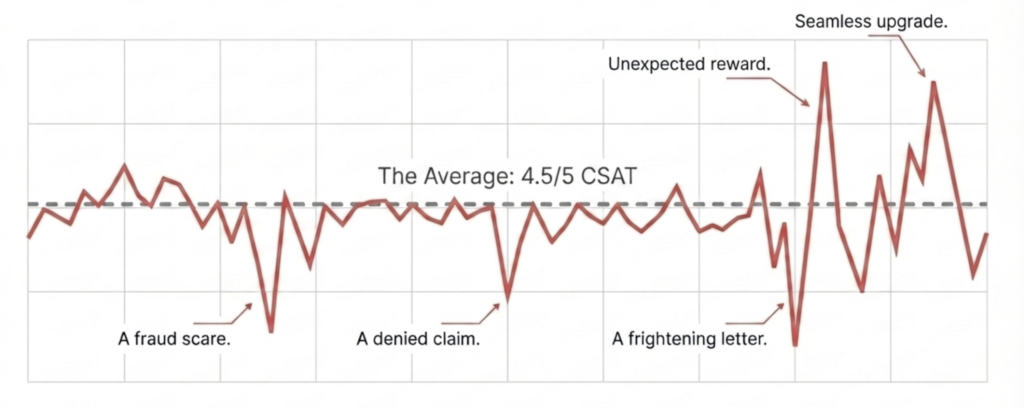
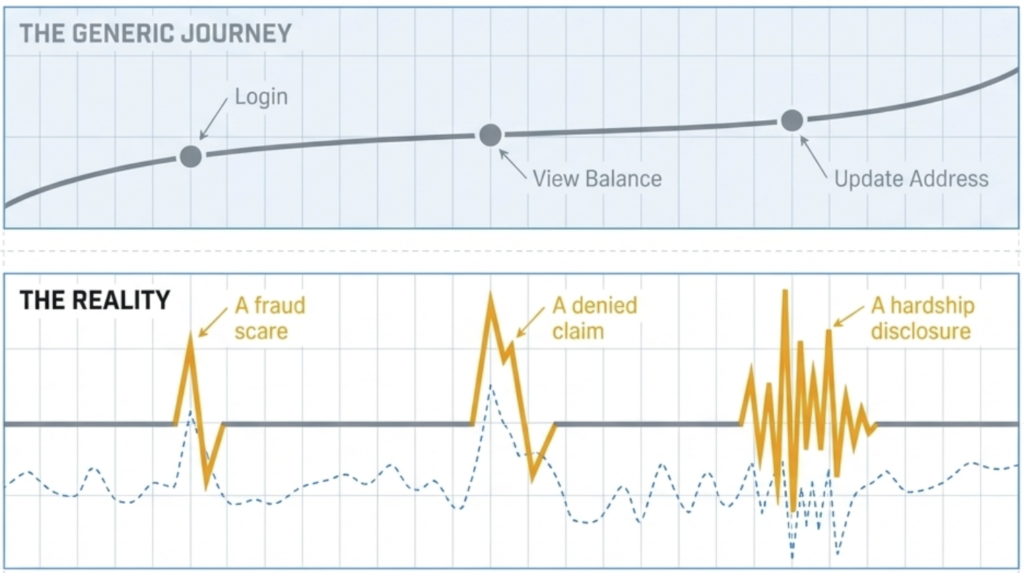
When you listen to customers, they rarely describe their relationship with a brand as a smooth curve. They describe a few sharp spikes. A fraud scare. A denied claim. A hardship disclosure. A major purchase. An outage. A frightening letter. These are the points that make or break trust.
AI has quietly, and permanently, raised the bar on what customers expect in those spikes. People are getting used to systems that anticipate needs, reduce friction, and respond in real time. They expect the organizations they rely on for money, health, safety, or identity to recognize when something important is happening and to adjust tone, speed, and options accordingly. This has opened a new frontier for customer delight, which an organization can capitalize on for proactive reassurance, timely guidance, and offers that feel helpful rather than pushy.
Those spikes are not evenly distributed across the journey. They concentrate in a small set of situations where emotion and risk are high. This is where experience, economics, architecture, and now AI intersect. The opportunity is not only to avoid nightmares when something goes wrong, but to use intelligence and design to turn those few critical moments into the reasons customers stay, spend, and advocate.
Averages hide nightmares and moments of delight
1.1 Moments as the real unit of competition
Three short narratives illustrate the point.
- A member gets a late night alert about suspicious activity on the account that pays the rent. The institution responds within minutes, explains clearly, resolves the issue without blame, and restores access safely. Months later, the member is still using that story to explain why they will not move their money.
- A customer discovers a serious billing error that threatens their credit score. They are transferred multiple times, receive conflicting information, and must resend the same documentation repeatedly. The issue is eventually fixed, but they close the account and tell others to avoid the brand.
- A family calls to request help after an unexpected job loss. The agent is empowered within policy to listen, adjust, and create a realistic plan. The family still faces hardship, but they leave feeling respected and supported, and they consolidate more of their business with that institution over time.
In each case, the underlying products and systems may be similar. What differs is how the moments land. Those moments decide whether the organization is experienced as a utility, a risk, or a partner.
From the customer’s perspective, the moments that matter compound into their experience. Customers do not carry a running average of every step in a journey; they remember the emotion from all the moments that mattered, updated over time and weighted by how intense the emotion was, how relevant the situation felt, and what the consequences were if things went wrong or very well.
Routine, low stakes interactions barely move the needle. High-stakes moments, especially those that involve fear, loss, vulnerability, or relief, move it sharply in either direction and dominate memory because people overweight emotional peaks and endings when they later judge the whole relationship. In practice, your “customer experience” is the accumulated, uneven sum of these moments, not the simple average of every touchpoint.
1.2 The business case for moment based design
The financial argument is clear and well supported.
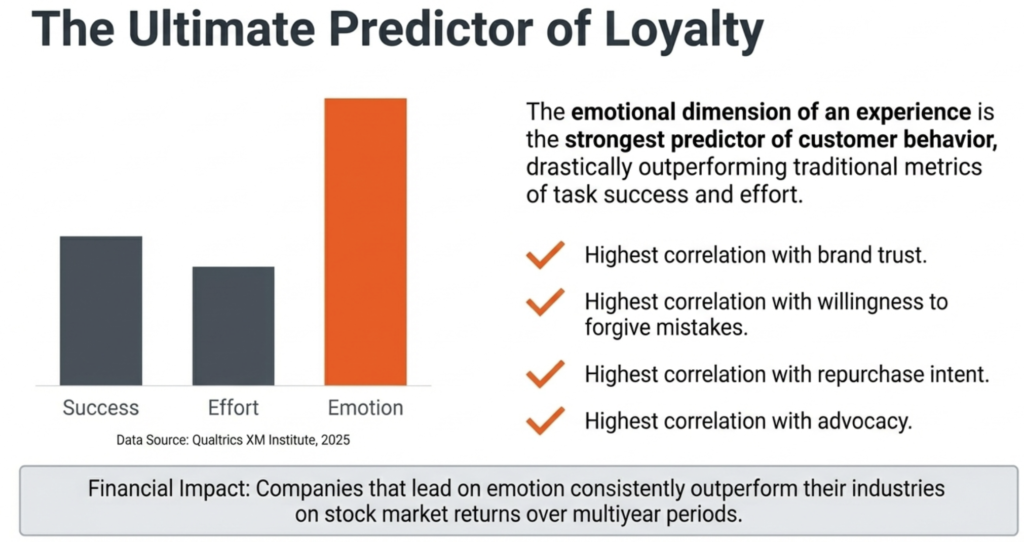
Research from Qualtrics shows that the emotional dimension of experience is the strongest predictor of customer loyalty, outperforming success and effort across trust, forgiveness, repurchase intent, and advocacy (Qualtrics XM Institute, 2025). In recent analyses of more than 350 brands, customers who report high positive emotion are several times more likely to trust a brand, forgive mistakes, buy more, and recommend it to others than those with low emotion scores.
Companies that lead on emotion also outperform their industries on stock returns, while emotion laggards fall well behind, widening the performance gap over time. At the same time, Qualtrics estimates that poor customer experiences put nearly 4 trillion dollars in global sales at risk annually, as customers take their spending elsewhere after bad interactions (Qualtrics, 2024)
These studies from Qualtrics separate emotion from success and effort show that emotion is the most powerful predictor of customer loyalty metrics, including trust, willingness to forgive, repurchase intent, and advocacy (Qualtrics XM Institute, 2025). Customers who report high positive emotion toward a brand are several times more likely to trust it, forgive mistakes, buy more, and recommend it compared with those who report low emotion, and companies that lead on emotion have outperformed their industries on stock market returns over a multiyear period. These findings suggest that how customers feel during their experiences is a major driver of financial performance, not a soft metric.
At the behavioral level, research on emotion detection in retail environments shows that emotionally connected customers are about three times more likely to make repeat purchases than other customers, and that AI driven emotion recognition systems can increase satisfaction by about 20 percent and lift sales by up to 30 percent when they are used to adapt responses in real time (ScanWatch, 2025). These gains come not from polishing every step in a journey, but from reacting better at the peaks of emotional intensity.
The common pattern is that emotion drives value. Emotion does not spike everywhere. It spikes in specific situations, and when it does, it matters.
1.3 The cost of getting moments wrong
The downside of mishandled moments is equally concrete. Recent global research from the Qualtrics XM Institute finds that organizations are putting approximately 3.7 to 3.8 trillion dollars in annual sales at risk due to bad customer experiences, a figure that has risen as consumer spending has grown (Qualtrics XM Institute, 2024; Qualtrics, 2024). In the 2025 “Bad Experiences Across 20 Industries” report, more than one in ten customer experiences worldwide are negative, and consumers report that they cut their spending with brands after those bad experiences, directly putting revenue at risk (Qualtrics XM Institute, 2025).
Other studies highlight how quickly customers are willing to walk away. Emplifi’s 2025 research finds that 70 percent of consumers say they will abandon a brand after just two negative experiences, and nearly a quarter say they would stop purchasing after only one bad experience (Emplifi, 2025). Forbes, summarizing Qualtrics XM Institute data, estimates that poor customer experiences could lead to around 3 trillion dollars in reduced or halted spending as customers decrease or cease purchases from brands that deliver inadequate service (Hyken, 2025).
At the level of daily operations, these global figures translate into familiar patterns. Revenue is lost when customers move their primary relationship elsewhere after a badly handled high stakes event. Operational costs increase when poor experiences drive repeat contacts, escalations, and long running cases that could have been avoided. Financial impacts are compounded by goodwill credits, waived fees, and write offs that are granted to repair damage after the fact. Reputational and regulatory risks emerge when clusters of poor experiences in high stakes situations show up in complaints, negative coverage, or supervisory scrutiny. These costs do not spread evenly across all touchpoints but cluster around a relatively small set of moments when people are frightened, uncertain, angry, or vulnerable.
At the level of daily operations, those global figures translate into:
- Revenue loss when customers move their primary relationship elsewhere after a badly handled high-stakes event.
- Operational drag from repeat contacts, escalations, long running cases, and manual workarounds required to repair damage that could have been prevented.
- Financial concessions such as waived fees, goodwill credits, and write-offs that could have been avoided if the first response had been more effective and humane.
- Reputational and regulatory exposure when patterns of failure in high-stakes situations lead to complaints, negative coverage, or supervisory scrutiny.
These costs are not spread evenly across all touchpoints. They cluster around a relatively small set of moments when people are frightened, uncertain, angry, or vulnerable.
1.4 Thesis: the moment as a first class design object
If most of the upside and downside is concentrated inside a handful of emotionally intense situations, then the moment should become a first class design object.
For practitioners, this leads to simple test questions:
- Can we name our most critical moments and describe what is at stake in each.
- Can we describe what the customer feels, what triggers the moment, what context changes its meaning, and how long we truly have to act before their judgment is set.
- Can we show where those elements live in our data, rules, channels, and operating model, not just in decks.
If not, then “moments that matter” is still a phrase, not an operating principle.
This paper proposes a practical anatomy for a moment and a compact artifact, the Moment Profile, that any business analyst, CX analyst, product team, or architect can apply.
2. What a Moment Really Is
We already have a rich vocabulary for experience and delivery: processes, journeys, interactions, use cases, scenarios. The idea of a “moment” can easily become vague unless we define it precisely.
2.1 Moment versus journey, interaction, and process
Each concept is useful and distinct, and they are connected.
A process describes how work flows inside the organization to produce outcomes. It is the internal view of steps, handoffs, and controls.
A journey describes how customers move through touchpoints and channels over time. It is the external view of sequences and paths across those processes.
An interaction is a single exchange along that journey: a click, a call, a message, a visit. Journeys are made of interactions; processes often power them behind the scenes.
A moment cuts across all three. A moment is a short period where:
- The customer has something meaningful at risk.
- Their emotions are heightened or fragile.
- The organization’s response significantly shifts trust, loyalty, or risk one way or another.
In other words, processes determine how the organization orchestrates its delivery of value, while customer journeys show when and where customers encounter the organization. The interactions, the visible touchpoints between the organization and its customers, are captured both in processes and journeys.
While a journey may contain dozens of interactions, only a few of them crystallize into moments that matter. These moments that matter are the emotionally and economically loaded intersections of all three and require closer attention.
Architecture and design decisions that ignore this asymmetry will spend effort evenly where stakes are not, while a moment based practice deliberately finds those few intersections where process, journey, and interaction combine to create outsized impact and treats them as design objects in their own right.
2.2 The five component anatomy
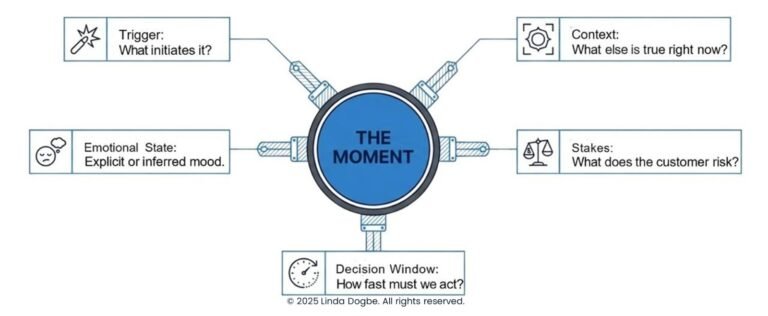
To use moments in analysis, design, and architecture, we need a structure that is simple, complete, and operational. In this series, we treat a moment as defined by five components:
- Emotions
How the customer feels in this situation, especially at the beginning, its peak and if it ends well. Common states in critical moments include anxiety, fear, confusion, frustration, guilt, shame, relief, gratitude, and renewed confidence. - Trigger
The specific, observable signal or combination of signals that indicates the moment is beginning. Triggers can be:- Customer initiated, such as a call, chat, or self service action.
- System detected, such as a fraud flag, a service outage, or a threshold crossing.
- Absence based, such as a missed payment where one was expected or a silent customer in a risky context.
- Context
The surrounding circumstances that change what the trigger means. Context includes who the customer is, what just happened, which channel they are using, environmental conditions, and crucially their intent in this situation. The same trigger can have very different implications depending on context. - Stakes
What is at risk in this moment for the customer and for the enterprise? This spans emotional stakes (fear, dignity, safety), financial stakes (money, assets, future value), operational stakes (complexity and cost of recovery), and reputational or regulatory stakes. - Decision window
The time span during which the organization must detect the trigger and respond if it wants to influence the outcome. This is defined by human perception and real world consequences, not by internal service level agreements. It answers, “how long do we really have before the decision is effectively made in the customer’s mind and in the business.”
These five components are not abstract. Each can be written down, instrumented, and governed.
3. The Moment Profile: Embedding the Anatomy into a Working Artifact
3.1 The Moment Profile definition
A Moment Profile is (preferably) a one page description of a high-stakes situation, written so that:
- CX sees the emotional and experiential stakes.
- Business analysts see the conditions and rules.
- Product managers see the intent and trade offs.
- Architects see the events, data, and timing constraints.
- Process teams see what must be true for frontline teams to succeed.
It is a compact lens that says, “This is the moment we are designing and operating for, and here is its anatomy.” As mentioned earlier, it can be mapped to a journey, value stream, or process.
3.2 The Moment Profile Overview
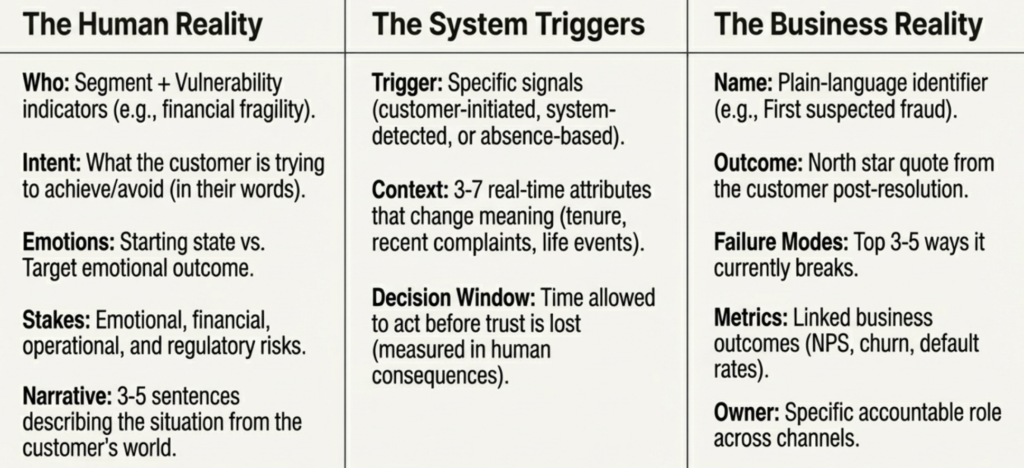
Below is a practitioner-ready structure that directly encodes the five components.
- Moment name: A Moment Profile starts with a clear moment name. Use plain language that a customer facing team would naturally use, such as “Critical payment at risk” or “First suspected fraud on primary card.” The name should immediately signal the situation to anyone reading it.
- Who experiences this moment: Next, describe who experiences this moment. Identify the primary segment or persona and call out any relevant vulnerability indicators, for example low digital access or financial fragility. This keeps the design anchored on real people rather than abstract averages.
- Narrative description: Provide a short narrative description in three to five sentences, written in customer language. Focus on what is happening in the customer’s world when this moment occurs and what they are thinking and feeling. This narrative helps teams visualize the situation and empathize with it.
- Customer intent: Capture the customer intent as part of the context. State what the customer is trying to achieve or avoid in their own words, such as “I need to know my money is safe” or “I need this fixed without destroying my credit.” Intent makes it clear what “good” looks like from the customer’s perspective.
- Emotions: Document the emotions involved. Note the likely starting emotions and the target emotional outcome if the moment lands well. For many high-stakes moments, this includes states such as fear, anxiety, confusion, and later relief, gratitude, or restored confidence.
- Trigger: Specify the trigger for the moment. List the specific signals that indicate the moment is starting and mark whether each is customer initiated, system detected, or absence based when something expected did not happen. This is what you will eventually instrument in data and events.
- Context: Describe the context. List three to seven attributes that materially change what the trigger means. These can include tenure and relationship depth, recent interactions or complaints, product mix or exposure, life event flags such as bereavement or job loss, and channel, region, or time of day. Include “current intent” explicitly so teams do not forget that context is relational and situational.
- Stakes: Clarify the stakes. Explain what is at risk in this moment. Cover emotional stakes for the customer, financial stakes for both the customer and the enterprise, operational stakes such as complexity and cost of failure, and reputational or regulatory stakes. Add simple tiering such as emotional high or medium or low and financial high or medium or low so teams can quickly see the relative importance.
- Decision window: Define the decision window. State how long the organization truly has to notice and act for the moment to land well, expressed in human terms such as real time, in minutes, same day, or before the next billing cycle. Add one sentence of rationale so the timing feels grounded in real consequences rather than internal service levels.
- Desired experience outcomes: Articulate the desired experience outcome. Describe how you want the customer to talk about this moment afterwards, ideally as a short quote style sentence. This becomes the north star for design, content, and tone.
- Failure modes: List the known failure modes. Capture the top three to five ways this moment currently goes wrong in reality based on complaints, call listening, and frontline input. This helps teams avoid repeating known mistakes.
- Linked business outcomes: Link the moment to business outcomes. Identify the metrics that move when this moment goes well or badly, such as churn, card usage, default rates, complaint rate, or NPS for the affected segment. These measures will later support prioritization and investment cases.
- Owner: Finally, name the owner. Assign a specific accountable role that owns the behavior of this moment across channels and functions. Without a clear owner, the moment will drift between teams.
4. Using the Moment Profile to Shape Journeys, CX Design, and Architecture
With a Moment Profile, teams can immediately start using the insights to shape work in three directions: journeys, customer experience and product design, and architecture.
4.1 Shaping journeys: from generic flows to moment led journeys
With a Moment Profile in hand, a journey map becomes more than boxes and arrows. Journey owners can overlay the Moment Profile onto the journey, marking exactly where a moment begins and ends from the customer’s perspective and annotating the journey with the starting and target emotions from the profile. They can also ensure the journey explicitly calls out the trigger and the decision window so teams can see where time really matters.
This shifts conversations from “Step 3 to step 4 is a call transfer” to “This is the moment where a long tenured customer is afraid something important is at risk. The decision window is minutes to hours. All steps inside this window must be designed around reassurance and clarity, not generic routing.” It helps teams decide which steps are truly critical to redesign and which can remain “good enough” for now. Teams can also align journey priorities with stakes, not just with visible pain points, and identify where multiple journeys share the same moment and should share design and investment.
4.2 Shaping CX and product design: from principles to concrete specs
CX and product teams can turn the Moment Profile into specific design decisions across content, channels, and paths.
For content and tone, teams can use the target emotion to guide messaging so that it is short, clear, non blaming, and focused on safety, clarity, or resolution as appropriate to the situation. They can avoid language that implies negligence or carelessness unless there is clear evidence, in order to preserve the customer’s dignity in high-stakes moments.
For channel strategy, teams can use the decision window to justify proactive outreach via the fastest reliable channels, such as a combination of notifications, SMS, or email, rather than waiting for inbound contact. They can also ensure there is at least one low friction path to a human for customers who are highly anxious, vulnerable, or less comfortable with digital flows in that moment.
For options and paths, teams can use the stakes to decide which self service options are appropriate and when a human must be involved. They can provide immediate temporary protections or safeguards, along with clear guidance on next steps, while any deeper investigation or processing continues in the background.
From a requirements perspective, teams can write user stories that directly reference the moment. For example, “As a customer in a high-stakes situation, I want a clear explanation within minutes of what is happening, what has been done to protect me, and what I need to do next, so that I feel safe and remain in control.” In this way, emotional considerations and the decision window become concrete constraints that shape content, channel, and flow design rather than remaining abstract principles.
4.3 Shaping architecture: from abstract “real time” to concrete choices
Architecture and data teams can use the same Moment Profile to make concrete design and technology choices.
For triggers and events, the Trigger field identifies which events need to exist and what payload they must carry. Teams can define specific events with the fields required to populate the Context elements of the Moment Profile.
For context, the Context field indicates which attributes must be available in real time at decision time. This drives requirements for customer context services, event enrichment, or targeted data integration, instead of broad and unfocused efforts to build generic “360 degree views.”
For non-functional requirements, the stakes classification supports stronger service level objectives, error budgets, and resilience patterns for systems that support high-stakes moments. It also justifies well defined fallback plans so that, if digital systems are degraded, frontline teams can still support the moment through alternative channels such as voice or in person service.
For processing patterns, the decision window clarifies whether batch processing is acceptable or whether streaming or near real time capabilities are required. If the decision window is measured in minutes rather than days, this provides a specific business case to move selected flows to more responsive processing patterns.
In short, the Moment Profile becomes a bridge from moments as stories to moments as requirements, service levels, events, and architectural patterns. Without changing existing tooling, organizations can start by ensuring that every critical initiative has at least one Moment Profile and that those profiles are actively referenced in journey work, design decisions, and architectural decisions.
Conclusion
The case for treating moments as first class design objects is both human and economic. Customers do not remember averages. They remember a handful of emotionally intense situations when something important was at stake and the organization either showed up well or failed them. Those moments, not the sum of every interaction, define trust, loyalty, and risk over time.
This first paper has proposed a simple but operational way to work with those situations. The anatomy of a moment gives teams a shared language for emotions, triggers, context, stakes, and decision windows. The Moment Profile turns that anatomy into a practical artifact that business, CX, product, and architecture teams can all use without changing their existing tools. It allows moments to be named, described, and owned, rather than remaining as anecdotes in complaints and workshops.
Once a Moment Profile exists, it can shape journeys, design decisions, and architecture in concrete ways. Journeys become anchored in the few steps where emotion and stakes spike, rather than in every step equally. CX and product decisions can be tied explicitly to target emotions and real decision windows. Architects and data teams can translate the same profile into events, data requirements, and non-functional priorities that fit the stakes of the moment.
Part 1 has focused deliberately on the anatomy of a moment and the core artifact needed to make it real in practice. The rest of the series will build outward from this foundation. Subsequent papers will show how moments combine into journeys, how requirements can be written in moment centric form, how architectures and operating models can prioritize the highest stakes situations, how AI can be applied thoughtfully at the point of emotion, and how organizations can measure performance at the level of moments, not just channels or products.
References
Qualtrics XM Institute. (2025). How to capture the untapped financial value of customer emotions. Qualtrics International.
ScanWatch. (2025). How emotion detection can improve customer experience in retail. ScanWatch.
Qualtrics. (2024). Bad customer experiences put nearly $3.8 trillion at risk in global sales. Qualtrics International.
Emplifi. (2025). Report: 70% of consumers leave due to poor experience. Emplifi.
- Executive Summary
- 1. Why Moments, Why Now
- 1.1 Moments as the real unit of competition
- 1.2 The business case for moment based design
- 1.3 The cost of getting moments wrong
- 1.4 Thesis: the moment as a first class design object
- 2. What a Moment Really Is
- 2.1 Moment versus journey, interaction, and process
- 2.2 The five component anatomy
- 3. The Moment Profile: Embedding the Anatomy into a Working Artifact
- 3.1 The Moment Profile definition
- 3.2 The Moment Profile Overview
- 4. Using the Moment Profile to Shape Journeys, CX Design, and Architecture
- 4.1 Shaping journeys: from generic flows to moment led journeys
- 4.2 Shaping CX and product design: from principles to concrete specs
- 4.3 Shaping architecture: from abstract “real time” to concrete choices
- Conclusion
- References